
Choosing the right platform to build your online business is one of the most foundational decisions you will make.
In the vast world of website builders, two names consistently rise to the top: Shopify and Squarespace.
The Shopify vs Squarespace debate is a critical one because while both platforms empower you to create a beautiful online presence, they are engineered with fundamentally different philosophies.
One is a pure, unadulterated commerce engine, while the other is a design-first platform with powerful eCommerce capabilities.
The stakes in making this choice are higher than ever in 2026. Global eCommerce is a multi-trillion-dollar industry, and your website platform is the engine for your slice of it.

A powerful platform can supercharge your growth; a poor fit can lead to frustration and lost sales.
With over 73% of consumers stating that a positive website experience is a key factor in their brand loyalty, and 88% unlikely to return after a bad one, your platform choice directly impacts your bottom line.
Furthermore, with mobile commerce now accounting for over 60% of all online sales, your chosen platform must deliver a flawless mobile experience.
This in-depth guide will provide a detailed, head-to-head comparison of Shopify and Squarespace.
We will go beyond surface-level features to analyze their core eCommerce power, design flexibility, SEO tools, and pricing structures to help you make an informed, confident decision that aligns perfectly with your business goals.
Key Takeaways
- The Core Difference: Understand the fundamental distinction: Shopify is a commerce-first platform designed to handle complex retail operations, while Squarespace is a design-first platform with excellent, integrated eCommerce features.
- eCommerce Power vs. Simplicity: See why Shopify’s vast app ecosystem and advanced inventory management make it the undisputed king for serious, high-volume retail, while Squarespace offers a more streamlined, built-in toolset perfect for many businesses.
- Design Flexibility Showdown: Learn why Squarespace is renowned for its award-winning, visually stunning templates, while Shopify’s design capabilities are highly versatile but often more focused on conversion.
- The True Cost of Selling: Get a transparent breakdown of the pricing plans and, more importantly, the transaction fees for both platforms, so you can understand the real cost of each sale.
- Who Wins for Your Business? Receive a clear, scenario-based verdict to help you decide which platform is the ideal fit, whether you’re a creative professional, a service-based business, or a dedicated eCommerce retailer.
Who is Shopify For?
Shopify is a dedicated eCommerce platform built for one primary purpose: to help you sell products. It’s designed for businesses of all sizes, from dropshipping startups to enterprise-level brands like Allbirds and Heinz.

If your business model revolves around selling physical or digital goods, especially at scale, Shopify is the industry standard.
Who is Squarespace For?
Squarespace is a design-centric, all-in-one website builder. It’s famous for its beautiful templates and intuitive, user-friendly editor.
While it has powerful eCommerce functionality, its core strength lies in helping creatives, service-based businesses, and content creators build visually stunning websites with ease.

If your website’s primary goal is to showcase a portfolio, book clients, or publish content, while also having the ability to sell products, then Squarespace is a top contender.
Quick Comparison Table: Shopify vs Squarespace
| Feature | Shopify | Squarespace |
| Primary Focus | eCommerce Engine | Design & Content Platform |
| Ease of Use | Very user-friendly for commerce | Exceptionally user-friendly for design |
| Inventory Management | Advanced, multi-location | Strong, but best for simpler needs |
| Payment Gateways | 100+ options | Limited (Stripe, PayPal, Square) |
| App/Extension Store | Massive (8,000+ apps) | Smaller, curated extensions |
| Point of Sale (POS) | Robust, deeply integrated POS Pro | Good, via Square integration |
| Design & Templates | Good, conversion-focused | Excellent, award-winning designs |
| SEO Control | Very good (rigid URLs) | Excellent (flexible URLs) |
| Blogging & Content | Basic to Good | Excellent |
| Transaction Fees | 0% with Shopify Payments | 3% on Business plan, 0% on Commerce plans |
| Best For | Serious retail, large catalogs | Creatives, services, content + commerce |
Shopify vs Squarespace Pricing Comparison Table
| Platform | Squarespace | Shopify |
| Entry eCommerce Plan | Personal ($25/month) | Basic ($25/month) |
| Mid-Tier eCommerce Plan | Business (36$/month) | Grow ($65/month) |
| Advance eCommerce Plan | Commerce (Basic)(40$/month) | Advance (399$/month) |
| Business eCommers Plan | Commerce(advance) (72$/month) | Plus (2300$/month) |
| Transaction Fees | 3% on Business, 0% on Commerce plans | 0% with Shopify Payments (0.6-2% with others) |
Shopify vs Squarespace Head-to-Head In-Depth Comparison
Let’s break down how Shopify and Squarespace compare across the most critical categories for any online business.
1. eCommerce Power and Sales Features
This is the category where the core philosophical difference is most apparent.
Shopify:
This is Shopify’s home turf. It is a commerce machine.
Inventory Management:
Offers advanced, professional-grade inventory tools, including multi-location inventory, purchase orders, and detailed tracking.
Payment Gateways:
Integrates with over 100 payment gateways globally, in addition to its own excellent Shopify Payments, which simplifies transactions.
App Store:
The Shopify App Store is its superpower, with over 8,000 third-party apps for everything from dropshipping and subscriptions to advanced analytics and loyalty programs.
Point of Sale (POS):
Offers a robust POS system that seamlessly integrates your online and in-person sales, making it ideal for businesses with a physical retail presence.
Squarespace:
Squarespace offers a strong and comprehensive set of built-in eCommerce tools, but it is not as deep as Shopify’s.
Inventory Management:
Provides solid inventory management for most small to medium-sized businesses, including stock level alerts and product variations. However, it lacks the advanced multi-location capabilities of Shopify.
Payment Gateways:
Supports major gateways like Stripe, PayPal, and Square, but the selection is much smaller than Shopify’s.
Extensions:
The Squarespace Extensions marketplace is growing, but is significantly smaller and less diverse than the Shopify App Store. You rely more on Squarespace’s excellent native features.
Point of Sale (POS):
Offers a POS solution through a partnership with Square, which is great for many businesses but may not be as deeply integrated as Shopify’s native POS Pro.
Verdict:
For pure, scalable eCommerce power, Shopify is the undisputed winner. Its vast app ecosystem and enterprise-level inventory features make it the superior choice for any business that plans to scale its retail operations significantly.
Squarespace is more than capable for many businesses, but is best suited for those with less complex inventory needs.
2. Design Flexibility and Templates
This is where Squarespace has historically built its stellar reputation.
Squarespace
Design is Squarespace’s core strength.
Templates:
Offers around 150+ award-winning, professionally designed templates that are renowned for their beauty, modern aesthetic, and mobile responsiveness.

You can be confident that any template you choose will look incredible.
Editor:
Uses a highly intuitive, section-based drag-and-drop editor (Fluid Engine).
It provides a great balance of creative freedom and design guardrails, making it easy to create a polished site without “breaking” the design.
Shopify
Shopify’s design capabilities are powerful and conversion-focused.
Templates:
The Shopify Theme Store offers over 100 premium and free themes.
While many are stylish and professional, the primary focus is on clear navigation and conversion rate optimization, sometimes at the expense of the high-design aesthetic found on Squarespace.
Editor:
Shopify’s Online Store 2.0 editor allows for drag-and-drop customization with sections and blocks on all pages, providing a high degree of flexibility.
However, it can feel slightly less intuitive for pure design tasks compared to Squarespace.
Verdict:
For out-of-the-box stunning design and ease of use, Squarespace has the edge.
It’s the ideal choice for creatives, photographers, and brands where a sophisticated aesthetic is the top priority.
Shopify is highly customizable but requires more effort (or a more expensive theme) to achieve the same level of design polish.
3. SEO and Marketing Tools
Both platforms provide a strong set of SEO and marketing tools to help you get found by customers.
Shopify:
SEO:
Provides all the essential SEO tools you need: customizable meta titles and descriptions, alt text, and automatically generated sitemaps.
However, it has a rigid URL structure (e.g., /collections/ and /products/ are forced), which is a minor frustration for SEO purists.
Marketing:
Features a powerful, built-in email marketing platform (Shopify Email) and a vast app store for advanced marketing automation, loyalty programs, and more.
Its multi-channel integrations for selling on TikTok, Instagram, and Google are best-in-class.
Squarespace:
SEO:
Squarespace offers excellent SEO tools, giving you full control over all necessary on-page elements. It allows for more flexible URL structures than Shopify.
It also provides helpful checklists and guides to walk you through SEO best practices.
Marketing:
Includes a beautiful and integrated email marketing platform, social media content creation tools, and promotional pop-ups.
While its native tools are excellent, its extensions marketplace for marketing is smaller than Shopify’s.
Verdict:
It’s a tie, with a slight edge to Shopify for commerce-focused marketing.
Squarespace offers slightly more control over technical SEO elements like URLs, making it fantastic for content-driven sites.
However, Shopify’s vast app ecosystem and deep multi-channel sales integrations give it an advantage for businesses focused on product marketing.
4. Pricing and Transaction Fees
This is a critical comparison, as the true cost involves more than just the monthly subscription.
Shopify:
Offers several pricing tiers, generally starting from around $39/month for the “Basic Shopify” plan.

Transaction Fees: If you use their native Shopify Payments, there are no additional transaction fees.
If you use a third-party gateway, they charge a fee of up to 2% per transaction on top of what the gateway charges.
Squarespace:
Also offers several tiers, with eCommerce functionality starting on their “Business” plan (around $33/month).
Transaction Fees: The “Business” plan has a 3% transaction fee.
To get 0% transaction fees, you must upgrade to their “Commerce” plans, which start at around $36/month.
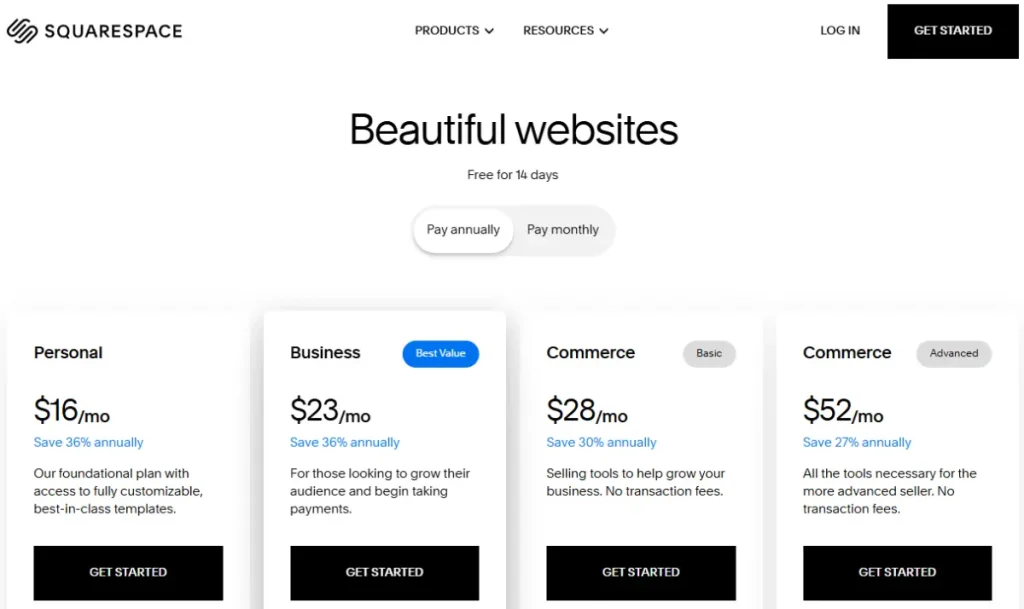
Verdict:
For businesses that will be on a starter plan, Shopify often works out to be more cost-effective once you factor in transaction fees.
Squarespace’s 3% fee on its entry-level commerce plan can add up quickly. However, on higher-tier plans, the pricing is very competitive.
Which is Better For You? A Scenario-Based Guide
For the Serious eCommerce Retailer:
If your primary goal is to sell products online at scale, manage a large inventory, or run a dropshipping business, Shopify is the clear winner.
Its powerful backend, vast app store, and scalable infrastructure are built for retail.
For the Creative Professional or Artist:
If you are a photographer, designer, or artist, your website is your portfolio first and your store second. Squarespace is the ideal choice.
Its stunning templates and design-focused editor will showcase your work beautifully, while its integrated commerce features are perfect for selling prints, digital products, or merchandise.
For the Service-Based Business (Consultant, Coach, etc.):
If you need to book appointments, sell services, and publish content, Squarespace is generally the better fit.
Its built-in scheduling tool (Acuity Scheduling) is best-in-class, and its strong blogging and design features help you build a professional brand.
For the Blogger or Content Creator:
If content is at the heart of your business and you want to monetize through merchandise or digital products, Squarespace has the advantage.
Its superior blogging platform and design-first approach make it better for creating a rich content experience.
Here’s another resource worth checking out:
👉 Webflow vs Shopify: Which One is Best for eCommerce?
👉 Shopify Review 2026 Features Pros And Cons: Is It Right for You to Build Online Store?
👉 WordPress vs Squarespace vs Wix (2026): Which Website Builder Should You Choose?
Frequently Asked Questions (FAQ)
Can I use Squarespace for a large eCommerce store?
You can, but you may run into limitations. Squarespace is excellent for stores with hundreds of products, but if you have thousands of SKUs, complex variations, and need multi-location inventory, you will likely find Shopify’s dedicated infrastructure more robust and scalable.
Is it easy to switch from Squarespace to Shopify (or vice versa)?
Switching platforms is a significant undertaking. While you can export some data (like products via CSV), you will need to completely rebuild your website’s design and content on the new platform. It’s best to choose the right platform from the start.
Which platform is better for dropshipping?
Shopify is hands-down the better platform for dropshipping. Its app store has deep integrations with all major dropshipping suppliers (like AliExpress, Printful, and CJdropshipping), making it incredibly easy to import products and automate fulfillment.
Do I need to know how to code to use either platform?
No. Both Shopify and Squarespace are designed to be used without any coding knowledge. However, both platforms do allow for custom code injection (CSS and JavaScript) for users who want more advanced customization.
Which platform has better customer support?
Both Shopify and Squarespace offer excellent 24/7 customer support via email and live chat. Shopify also offers phone support on some plans. Both are highly regarded for their helpful and responsive support teams.
Conclusion: A Choice Between Commerce Power and Design Elegance
The Shopify vs Squarespace decision is not about choosing a “better” platform, but about choosing the right platform for your specific business needs.
Choose Shopify if your business lives and breathes retail. It is an unparalleled, commerce-first powerhouse designed to help you sell more products, manage complex operations, and scale your store to any size.
Choose Squarespace if your business is built on your brand’s aesthetic, your content, or your creative services.
It is a design-first leader that empowers you to create a stunningly beautiful website with ease, while still providing robust and seamless tools to sell products and services.
By carefully evaluating your primary business goals against the core strengths of each platform, you can confidently select the right foundation to build and grow your online presence in 2026.