
Most websites chasing organic traffic are still playing by a rulebook that no longer applies. They target keyword volumes, publish mediocre content, and wait for rankings to arrive. Meanwhile, the way search actually works has shifted underneath them.
Search engines no longer just match keywords to pages. They interpret intent, surface AI-generated answers, and reward content that can be cited, extracted, and trusted at scale. The businesses pulling ahead are the ones using AI search optimization tools not just to rank, but to show up where decisions are being made.
In this guide, you’ll learn:
- What AI search optimization tools actually do differently from traditional SEO software
- How they drive organic traffic through intent matching, content gaps, and LLM visibility
- Which specific capabilities move the needle and why
- What the data says about AI-driven traffic quality versus volume
- How to build a strategy that works across Google, ChatGPT, Perplexity, and AI Overviews
By the end, you’ll have a clear picture of where AI tools fit into your SEO workflow and how to use them without getting lost in the hype.
Key Takeaways
- AI search optimization tools analyze intent patterns and content gaps that traditional keyword research misses entirely.
- Getting cited in AI Overviews and LLM answers drives lower-volume but significantly higher-converting traffic.
- According to Ahrefs internal data (2025), AI-referred visitors convert at rates up to 23 times higher than standard organic search visitors.
- Structured, factually dense content with clear authorship signals earns more citations from AI systems.
- Combining traditional SEO with GEO (Generative Engine Optimization) and AEO (Answer Engine Optimization) gives you coverage across all search surfaces.
- Content that earns AI citations often ranks outside the traditional top 10, meaning authority matters more than position alone.
Quick Answer
AI search optimization tools increase organic traffic by identifying how real users phrase questions to search engines and LLMs, filling content gaps, and structuring pages so that AI systems can extract and cite your content in their answers. The result is visibility across traditional rankings and AI-generated responses, with cited content often driving traffic that converts at significantly higher rates than standard organic clicks.
What Has Actually Changed About Search in 2026
You cannot understand what AI SEO tools solve without first understanding what broke in traditional search.
For years, organic traffic meant one thing: rank in Google’s top 10, earn the click. That model held up well enough. Then AI Overviews started appearing. According to Conductor’s analysis of 21.9 million queries in Q1 2026, roughly 25% of Google searches now trigger an AI Overview panel at the top. When that panel is present, the Pew Research Center found that click-through rates drop from 15% to 8% on the same queries.
That does not mean organic is dying. According to Graphite’s January 2026 data, organic search traffic in the US declined only about 2.5% between early 2024 and late 2025, far less than the doom-and-gloom forecasts predicted. But where that traffic goes has changed. The question is no longer just “can my page rank?” It is “Will my content get cited, referenced, or surfaced in an AI answer?”
That is the gap AI search optimization tools are built to close.
Why Traditional SEO Tools Fall Short
Traditional SEO Tools were built to answer one question: how do I rank for this keyword? They track rankings, audit technical issues, and suggest on-page changes based on what the current top-10 pages look like.
That is still useful work. But it misses two things that matter enormously now.
First, AI systems do not just pull from page-one results. According to Ahrefs (June 2025), websites with strong organic traffic tend to get more mentions in AI Overviews and Perplexity, but ChatGPT regularly cites pages ranking in positions 21 and beyond. Traditional tools do not track or optimize for that surface at all.
Second, LLMs interpret meaning, not just keywords. They read context, weigh authority signals, and pull content that directly answers a specific query in a credible way. Optimizing for that behavior requires a different layer of analysis than checking keyword density on a page.
How AI Search Optimization Tools Actually Work
At the core, these tools use machine learning to do what human analysts cannot do manually at scale: process enormous amounts of SERP data, user behavior signals, and content performance metrics simultaneously.
Here is what that looks like in practice.
Intent Mapping Beyond Keyword Volume
Traditional keyword research starts with a seed term and expands based on search volume and competition scores. You get a list of phrases. You target the ones with the best volume-to-difficulty ratio. That approach worked when Google was primarily a keyword-matching system.
AI tools approach this differently. Rather than returning a list of phrases, they cluster queries by the underlying intent. Someone searching “best CRM for SaaS startups under 50 employees” and someone searching “lightweight CRM for small teams” are expressing nearly identical intent. An AI keyword tool groups those together and tells you what kind of content satisfies both.
This matters for organic traffic because matching intent precisely is what signals to Google that your content deserves to rank. It is also what signals to an LLM that your content is worth citing.
Content Gap Detection at Scale
One of the most practical ways AI tools drive organic traffic is by surfacing topics your site has not covered that your audience is actively searching for.
When I have worked through content audits with AI tools, the pattern I see most often is not that a site is publishing bad content. It is that the site has entire subtopics missing because no one ran a systematic analysis. A financial services site might cover retirement planning broadly but have zero content addressing specific life events like job changes or inheritance. Those gaps represent real traffic.
AI tools identify these gaps by analyzing what pages currently rank for a set of related queries, then comparing that against your existing content. The output is a prioritized list of topics that have search demand and low competitive saturation. That directly translates into traffic opportunity.
Semantic Coverage and NLP Optimization
Search engines and LLMs do not evaluate your content one keyword at a time. They assess whether your page covers a topic with appropriate depth and context.
AI optimization tools analyze what related terms, entities, and concepts appear across the highest-ranking content for your target topic. They then compare that against your draft or existing page, flagging what you are missing. Tools like Clearscope and Surfer SEO do this well during the editing phase, helping you add semantic coverage without turning the content into keyword soup.
The benefit for organic traffic is straightforward: pages with stronger semantic coverage tend to rank for a broader range of queries. One well-structured page can pull traffic from dozens of related searches you never explicitly targeted.
Technical SEO Prioritization
AI tools also change how technical SEO work gets done. Rather than presenting a flat list of 200 issues, the better platforms use machine learning to score which fixes will have the biggest impact on rankings and crawlability.
Page speed, Core Web Vitals, internal linking gaps, broken canonical tags. These are all real issues, but fixing a slow-loading category page matters far more than correcting an obscure schema attribute on a low-traffic blog post. AI tools learn from your site’s traffic data and SERP patterns to tell you which issues to fix first. That prioritization alone can save weeks of wasted developer time.
AI Overviews: The Traffic Channel Most Sites Are Not Optimizing For
When Google’s AI Overview cites your page, something specific happens. The Pew Research Center found that overall CTR drops when AI Overviews are present, but data from ZeroClick Labs shows that being cited within an AI Overview increases organic CTR from 0.6% to 1.08%. More meaningfully, Stackmatix’s analysis found that sites cited in AI Overviews gain roughly a 35% CTR advantage over non-cited pages at the same position.
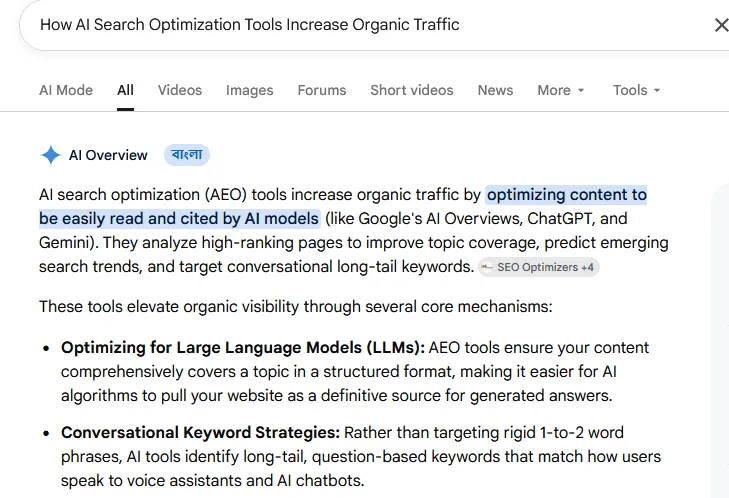
The traffic is smaller in absolute volume. The quality is significantly higher.
According to data from SEOmator citing Ahrefs internal figures (2025), AI-referred visitors convert at rates up to 23 times higher than standard organic search visitors. The reason makes intuitive sense: by the time someone follows a citation from an AI answer, they have already received an explanation of your solution. They arrive informed and closer to a decision.
How to Get Your Content Cited in AI Answers
AI systems do not pull from pages arbitrarily. They look for content with specific characteristics. AI search optimization tools help you engineer those characteristics.
Structured, extractable answers. LLMs prefer content that directly answers a question within the first few sentences of a section. If you bury your answer in three paragraphs of context, the AI moves on to a page that leads with the answer. Structuring your content so that each section opens with a direct response and then expands on it dramatically improves citation probability.
Factual specificity. Vague claims get skipped. Specific claims with named sources get cited. A sentence like “site speed improvements of this scale correlate with significant traffic gains” is forgettable. A sentence like “when a client’s page load time dropped from 4.2 to 1.8 seconds, organic traffic increased 43% within two months” gives an AI system something concrete to reference. AI tools now help you identify where your content lacks specificity and where adding a data point or case study would improve citation performance.
Authoritative authorship signals. AI systems use E-E-A-T signals to decide which sources to trust. Detailed author bios with credentials, first-person experience language, and external mentions of your brand or name all contribute. According to Position Digital (2026), branded web mentions have a correlation score of 0.664 with AI Overview appearances, significantly stronger than backlinks at 0.218.
Recency. AI search systems, particularly ChatGPT and Perplexity, favor recently updated content. AI SEO tools now flag content that has gone stale relative to when it was last updated and recommend when pages need a refresh to maintain citation relevance.
Generative Engine Optimization: The Discipline Behind AI Traffic Growth
GEO, or Generative Engine Optimization, is the systematic practice of making your content more likely to be cited and surfaced by AI-powered answer engines. It sits alongside traditional SEO rather than replacing it.
According to research published on Arxiv, GEO-style optimization changes increased content visibility in generative engine responses by up to 40% in controlled tests. ZeroClick Labs reports that strategic AI citation optimization can produce a 383% increase in AI-driven clicks within 90 days for brands starting from a low citation baseline.
These numbers vary by industry and starting point, but the direction is consistent: structured, authoritative content earns more citations, and more citations drive more qualified traffic.
GEO vs. AEO: Understanding the Difference
These two terms are sometimes used interchangeably, but they describe slightly different things.
GEO (Generative Engine Optimization) focuses on getting your brand and content cited within the generated outputs of AI systems like ChatGPT, Perplexity, and Google’s AI Overviews. The goal is to be the source an AI references when constructing an answer.
AEO (Answer Engine Optimization) is broader. It covers optimizing for any system that answers questions directly, including voice search, featured snippets, and knowledge panels. AEO asks: when someone asks a question, is your content the answer that surfaces?
AI search optimization tools now address both surfaces. Platforms like Otterly AI and Peec AI specifically track how often your brand appears in LLM-generated responses and what sentiment those mentions carry, which is a layer of visibility reporting that did not exist two years ago.
What Content Strategy Looks Like When AI Tools Are in the Workflow
The biggest change I see when teams integrate AI search optimization tools properly is not that they produce more content. It is that they stop producing content that goes nowhere.
Before AI tools, content strategy often started with a keyword list and ended with a published page. Whether that page ever earned meaningful traffic was often unclear until months later, and the diagnosis was hard to pin down.
With AI tools in the workflow, the process tightens considerably.
Building Topical Authority Instead of Chasing Single Keywords
LLMs are trained to trust sources that demonstrate consistent expertise across a topic cluster, not just individual pages that rank for isolated terms. This is a meaningful shift from keyword-by-keyword targeting.
The content cluster approach works like this: you build a comprehensive pillar page covering a broad topic in depth, then create a set of supporting pages that go deeper on related subtopics. Each page links to the others. The entire cluster signals to both Google and LLMs that your site is a credible, comprehensive source on that topic.
AI tools help you design these clusters by identifying which subtopics have search demand, which ones your competitors cover thoroughly, and which ones represent gaps you can own. The result is a content architecture built for sustainable organic traffic rather than a collection of isolated posts.
Optimizing Existing Content Before Publishing New Pages
One of the highest-return activities AI tools enable is improving content that already exists. Most sites have pages that used to rank well, pages that rank on page two and could be pushed to page one with targeted improvements, and pages that have never gained traction despite covering relevant topics.
AI tools identify which pages have traffic decline worth investigating, which have ranking potential that has not been realized, and what specific changes would improve their performance. This is often faster and more impactful than publishing new content from scratch.
According to research cited by ZeroClick Labs (summarizing Brainwire 2025 data), websites publishing original expert content, including research and proprietary studies, see an average organic traffic increase of 29.7%. AI tools help you identify where adding original data or first-hand insight to an existing page can push it from generic to genuinely citeable.
The Data on AI-Driven Organic Traffic: What to Expect
It is worth being specific about what the traffic numbers actually look like so you can set realistic expectations.
Traditional organic traffic still dominates by volume. According to Conductor (November 2025), traditional organic traffic accounts for roughly 25% of all website traffic, while AI referral traffic accounts for about 1.08% on average. AI search is not replacing organic volume yet.
But the conversion story is different. Semrush’s research found that users arriving through non-Google AI search systems like ChatGPT convert at 4.4 times the rate of standard organic search visitors. Other analyses from Ahrefs and SEOmator put that conversion premium higher, with some B2B SaaS companies reporting AI-sourced visitors converting at 6 to 27 times the rate of organic visitors.
Traffic from LLMs grew 527% year over year based on a Previsible analysis of 19 GA4 properties reported through Search Engine Land. That is coming from a small base, but the trajectory matters for how you allocate optimization effort now.
Is Traditional SEO Still Worth the Investment?
Yes, unambiguously. And the data supports this clearly.
According to Ahrefs (June 2025), 76.1% of URLs cited in AI Overviews also rank in Google’s top 10 organic results. Winning traditional SEO rankings is still the most reliable path to AI citation as well. The strategies reinforce each other.
What has changed is that ranking alone no longer guarantees traffic. You now need to rank and be citation-ready. AI search optimization tools help you achieve both.
Which AI SEO Tools Are Worth Your Attention
The market has expanded quickly, so it helps to understand what category of problem each tool solves before committing.
For content optimization and semantic coverage: Clearscope and Surfer SEO are widely used. Clearscope analyzes your draft and recommends terms to include based on what currently ranks, flagging readability issues without pushing you toward keyword overload. Surfer SEO does a structural analysis of SERP leaders and suggests changes you can implement during the writing process.
For content strategy and briefs: Frase generates SEO-focused briefs based on live SERP data, helping writers structure content around what is already earning rankings. BlueprintIQ (from Siege Media) takes a broader approach, analyzing your industry and competitors to generate a content strategy rather than just individual briefs.
For LLM and AI citation monitoring: Peec AI and Otterly AI are built specifically for this. Peec tracks where your brand appears in LLM-generated responses and audits the sentiment of those mentions. Otterly AI monitors how competitors are performing across SERPs and AI answers, giving you a comparative view of citation performance.
For keyword research with intent depth: Scrunch provides AI keyword research with visual priority scoring across SEO initiatives, making it easier to see which opportunities are worth pursuing.
The best starting point is identifying your largest current gap, whether that is content briefs, SERP monitoring, or technical prioritization, and choosing one tool that addresses it before layering others.

Common Mistakes That Kill Results From AI SEO Tools
Having access to good tools does not automatically translate into organic traffic gains. The mistakes I see most often are predictable and avoidable.
Publishing generic AI-generated content at scale. AI writing tools can produce content fast, but fast and generic is not what earns citations or sustainable rankings. Search engines and LLMs are now quite good at detecting thin content. The output from an AI writing tool needs human expertise layered on top of it, not just a light edit.
Ignoring search intent in favor of search volume. A keyword with high volume but mismatched intent will bring visitors who immediately leave. AI tools surface intent data, but you have to use it. Chasing volume without checking intent is still one of the fastest ways to waste a content budget.
Optimizing for rankings and ignoring LLM visibility. If you are not tracking how your brand and content appear in ChatGPT, Perplexity, and Google’s AI Overviews, you are missing a growing share of the traffic picture. This is not a 2028 problem. It is happening now.
Treating tool output as final decisions. AI tools surface data and prioritize recommendations. They do not replace the judgment call about what your specific audience needs or what voice fits your brand. Use the data as input, not as instructions.
Frequently Asked Questions
What is the difference between AI SEO tools and traditional SEO tools?
Traditional SEO tools track rankings, audit technical issues, and suggest on-page changes based on what currently ranks. AI SEO tools go further by interpreting search intent, identifying content gaps across topic clusters, predicting which fixes will have the most traffic impact, and helping you optimize for visibility in AI-generated answers and LLM citations. The underlying difference is that AI tools process patterns across much larger datasets simultaneously and surface insights that manual analysis would take weeks to produce.
Can AI search optimization tools help smaller websites compete with large ones?
Yes, with some nuance. AI tools give smaller sites the ability to find underserved topic clusters where large competitors have not built deep authority. They also surface content gap opportunities that are easier to win because the competition is lower. The advantage is not that AI tools level the playing field entirely; it is that they show you exactly where the field is already tilted in your favor.
How long does it take for AI SEO optimization to show results in organic traffic?
Most technical and on-page changes show measurable impact within 4 to 12 weeks, depending on how frequently your site is crawled. Content strategy changes, particularly building topical authority through content clusters, typically take 3 to 6 months to compound into meaningful traffic gains. Improvements to AI citation frequency can be faster because LLMs update their knowledge more continuously than Google’s crawl cycle suggests.
Do I need to abandon traditional SEO to optimize for AI search?
No. The two approaches work best together. According to Ahrefs data (2025), 76.1% of URLs cited in AI Overviews also rank in Google’s top 10 organically. Building strong traditional rankings remains the most reliable foundation for AI citation as well. What changes is adding a citation-readiness layer to the content you already produce for SEO, which means structuring answers clearly, adding specific facts, and strengthening authorship signals.
What types of content perform best in AI Overviews and LLM citations?
Content with direct answers early in each section, specific data points with named sources, and clear authorship credentials tends to perform best. Question-and-answer formats, structured how-to guides, and comparison content with clear conclusions are particularly well-suited for AI extraction. Content that hedges every claim or buries the answer in lengthy preamble performs poorly in AI search, even if it ranks reasonably well in traditional results.
Is AI referral traffic worth pursuing if the volume is still small?
The volume is small, but the conversion quality is substantially higher, which makes the economics favorable even at lower numbers. If AI-referred visitors convert at 4 to 23 times the rate of standard organic visitors, as multiple studies have found, then a relatively small increase in AI traffic can drive outsized revenue impact. Optimizing for it now, while adoption is still growing, positions you to capture more of that traffic as LLM usage continues expanding.
Building a Strategy That Holds Up Across Search Surfaces
The brands with the strongest organic traffic in 2026 share one pattern: they stopped optimizing for individual Google features and started building genuine authority across their entire content presence.
AI search optimization tools are the mechanism that makes that shift practical. They surface intent patterns you would not find manually, identify the content your audience is searching for that you have not written yet, help you structure pages so that both humans and AI systems can extract value from them, and tell you where your citation presence in LLM answers is falling short.
The underlying work, writing content that demonstrates real expertise, answering questions directly, and earning external credibility, remains unchanged. What AI tools do is make that work more targeted and measurable so that less of it goes to waste.
If you have not audited how your content performs across both traditional rankings and AI answer surfaces, that is the right place to start. Identify your largest visibility gap, choose one tool that addresses it, and build from there.